There's a reliable signal that a format has stopped being a novelty and become part of the culture: the moment it gets parodied by the people at the very centre of the mainstream. In late July 2026, two of American television's biggest platforms reached for that exact move within a single week — and in doing so, marked the moment the microdrama officially arrived.
The story of how they did it tells you almost everything about where vertical drama is headed.
The late-night arms race that went vertical
On 21 July 2026, Comedy Central's The Daily Show announced it would produce late-night television's first microdrama — a political send-up provisionally titled Two Billionaires Fight to Dominate the Country. It was a natural fit for a franchise that has spent three decades turning satire into shareable, fast-moving comedy.
There was just one problem: announcing isn't releasing.
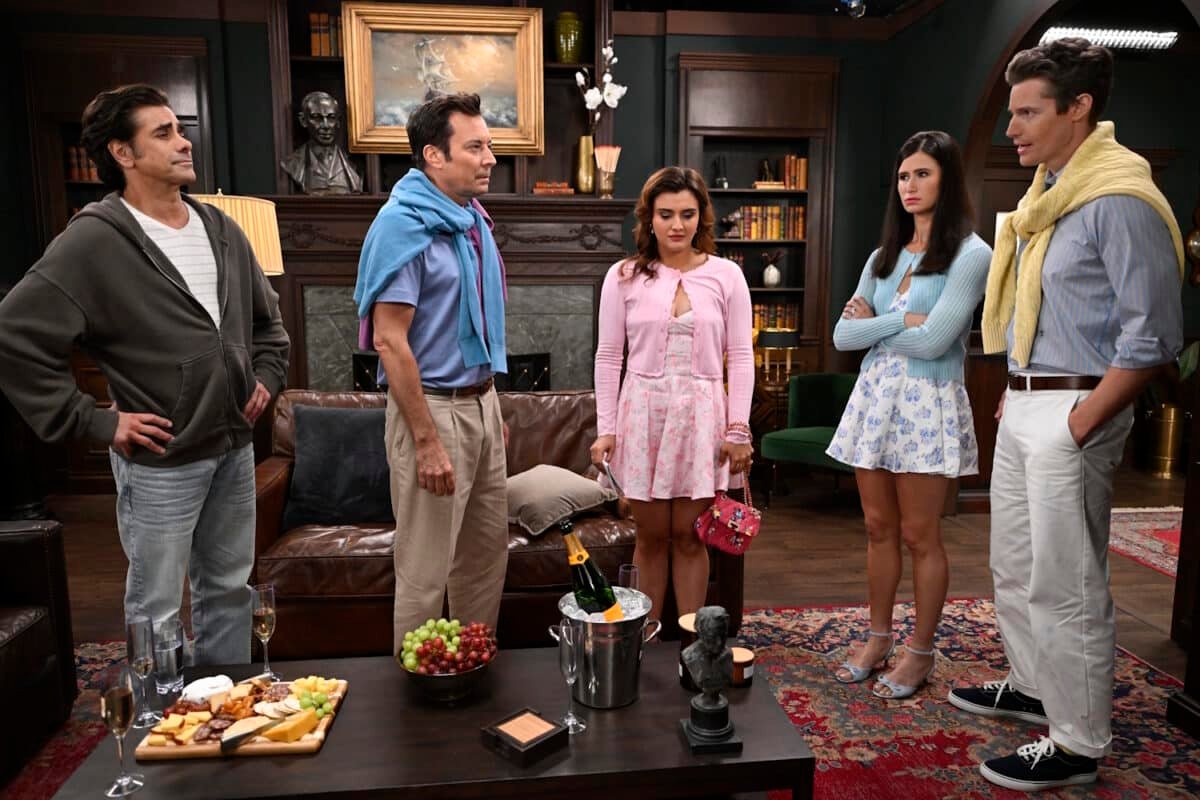
Six days later, on 27 July, The Tonight Show Starring Jimmy Fallon simply put its version out. Who Billionaire? Me Billionaire — a vertically shot soap-opera spoof written by head writer A.D. Miles — premiered during the broadcast and hit TikTok, YouTube, Instagram and a newly launched microdrama section on Peacock the same night. The cast paired Fallon with John Stamos, Tonight Show writer Rose Kelso, creator Delaney Rowe, and Kasey Esser, one of the genre's most prolific working actors.
The kicker: the whole thing was shot in a single day, on a scheduled day off, with a 30-person crew, a multi-cam setup and cue cards. A traditional microseries typically takes around ten days to shoot. Fallon's team compressed that to hours.
The Daily Show announced first. Fallon shipped first. As one outlet put it, the late-night wars aren't over — they've just gone vertical.
Why "shipped first" mattered more than "announced first"
Within a week, Who Billionaire? Me Billionaire had drawn more than 20 million views across its first eight episodes, and Fallon was already teasing a second season. Its opening TikTok episode cleared 900,000 views almost immediately.
It's worth being precise about the claim here, because it's easy to overstate. In raw numbers, this is not the most-watched vertical drama on Earth — hit titles on China's platforms routinely pass 100 million views, and the Chinese market serves more than 830 million viewers. But as the highest-profile vertical drama ever produced by a major Western entertainment brand, released on a legacy broadcast network and pushed straight to the platforms where the format actually lives, Who Billionaire? Me Billionaire is arguably the genre's biggest mainstream-crossover moment to date.
That distinction is the whole point. Microdramas spent three years building enormous audiences on dedicated apps largely outside the awareness of the traditional industry. The Fallon–Stewart episode is the moment the traditional industry stopped watching from the sidelines and picked up the camera. When a format is both big enough to spoof and worth racing your rival to spoof, it has crossed a threshold.
The numbers behind the boom
The tipping point wasn't caused by two late-night hosts. It was revealed by them. Underneath the joke sits one of the fastest-growing categories in entertainment.
The headline figures depend on who's counting and what they count, and the spread is genuinely wide:
- Omdia estimates global microdrama revenue at roughly $11 billion in 2025, rising to $14 billion in 2026, with about $3 billion generated outside China. The firm also reported that microdrama apps have overtaken Netflix, Disney+ and Prime Video in mobile engagement time — a striking measure of attention, not just spend.
- Deloitte takes a narrower, export-focused view, projecting in-app microdrama revenue near $7.8 billion in 2026 — more than double the prior year.
- Media Partners Asia tracks the origin market's trajectory: China's microdrama revenue climbed from about $500 million in 2021 to $9.4 billion in 2025, a point at which it surpassed the country's entire domestic theatrical box office. Outside China, MPA sizes the market at $1.4 billion in 2024, forecast to reach $9.5 billion by 2030 at a compound growth rate above 28%.
The gap between Omdia's $14 billion and Deloitte's $7.8 billion isn't a contradiction so much as a definitional one — Omdia folds in enormous domestic Chinese revenue, while Deloitte concentrates on international export markets. Both agree on the part that matters: the category is compounding at more than 30% a year.
A few adjacent data points fill in the picture. Microdrama app downloads passed 2.3 billion globally in 2025, more than doubling year over year. Category app-store revenue jumped from roughly $178 million in Q1 2024 to nearly $700 million in Q1 2025. At the company level, ReelShort reportedly drove around $1.2 billion in gross consumer spending in 2025 with more than 70 million monthly active users, while the more disciplined DramaBox reported $323 million in revenue and a rare net profit. And crucially for anyone betting on longevity, roughly 30% of US Millennials and Gen Z were already familiar with the format in early 2025, with nearly half of those watching more than they had a year earlier.
From a Chinese web-novel format to Main Street
None of this was supposed to work. In 2020, Quibi launched with $1.75 billion in funding, A-list talent and mobile-first episodes — and collapsed inside six months. The lesson the industry took away was that short-form premium video was a dead end.
The lesson was wrong. While Quibi burned through its war chest chasing prestige, a different model was compounding quietly in China: duanju, built not on star power but on data-driven iteration, web-novel source material, addictive cliffhanger structure and per-episode monetisation. That model has now travelled. The 2026 story is its arrival in Western markets — with the US expected to represent close to half of all non-China revenue — and its move from standalone apps into the mainstream, as platforms like HBO Max experiment with vertical feeds and Peacock stands up a dedicated microdrama section for a Tonight Show spoof.
The format is also outgrowing its own name. Research from Holywater Tech and Owl & Co notes the category is expanding well beyond its romance-heavy origins into comedy, thriller and satire, and diversifying its audience fast — the share of male monthly active users on one major platform rose from about 1% to over 30% in under two years. What began as "microdrama" is becoming, simply, vertical storytelling.
What the tipping point means for the category — and for filmmakers
For independent filmmakers, the Fallon–Stewart moment is more than an industry curiosity. It's a signal worth acting on.
Short-form is now a commercial category, not a consolation prize. For years, "make it short" was advice about constraint — smaller budgets, smaller ambitions, a stepping stone to the "real" work of features. The data has quietly inverted that. A vertical series can now reach audiences and revenue at a scale that competes with theatrical, and it can do so on production timelines measured in days. The short form isn't the minor leagues anymore.
Speed and format fluency are becoming real skills. The reason Fallon's team could beat a rival to air was that they understood the grammar of the format — the 90-second tension-and-release, the cold cliffhanger, the vertical frame — well enough to execute it fast. Filmmakers who can tell a genuinely good story inside those constraints, rather than treating vertical as a lesser version of horizontal, have a rare and increasingly valuable ability.
Discovery is the bottleneck, not production. The barrier to making short-form work has never been lower. The barrier to being found — and to turning views into a licensing conversation or a distribution deal — is where careers are actually made or stalled. That's precisely the gap FilmFore exists to close: structured evaluation that tells you whether the work lands, a shortlist that puts strong films in front of market partners, and a path from being seen to being sold.
The parody is the proof. When the culture is comfortable enough with a format to laugh at it on network television — and when two of the biggest names in comedy race each other to do it — the format has won. The open question is no longer whether vertical, short-form storytelling matters. It's who gets discovered inside it.
FilmFore is a discovery, evaluation and distribution platform for short-form storytelling — traditional short films and vertical drama alike. Submit your film and get it in front of the people who license and distribute work.